


Some of the most memorable food experiences in Mallorca and Ibiza don’t come from restaurants at all. They come from conversations – standing in a vineyard at sunset, breaking bread with a baker who still works before dawn, or tasting cheese made by someone who knows every goat by name.
Behind every good plate in the Balearics, there’s a producer. Often a family. Usually a story. And almost always, a deep connection to the land.
This is a personal look at some of the makers shaping Balearic food culture today – the cheesemakers, bakers and winemakers whose work quietly defines what ends up on local tables. Many of them supply the very places we visit on our Food Tours Balearics routes, even if their names never appear on the menu.
Why producers matter in Balearic food culture
In Mallorca and Ibiza, food has always been about place. The soil, the climate, the seasons – and the people who adapt to them year after year.
Small producers are the backbone of Balearic cuisine. They work on a scale that allows for care rather than shortcuts. They preserve techniques that don’t survive in mass production. And they give island food its identity.
When you taste a cheese here, you’re tasting grazing land. When you drink a local wine, you’re tasting sun, wind and limestone. That connection is what makes Balearic food so compelling – and why meeting the makers adds depth to every bite.
Mallorca: where tradition and innovation meet
Can Cavall Blau – farming the good life, slowly
Can Cavall Blau isn’t a traditional farm you stumble across – it’s a place you arrive at with intention. The project began in 2017, when its founders came to Mallorca searching for a slower, more meaningful way of life, and stayed for what their four rugged hectares made possible.
Today, Can Cavall Blau is an organically farmed, circular estate where horses are still part of the farming process and the land sets the pace. Vineyards of autochthonous Mantonegro sit alongside Merlot, olive and almond groves, and a surprising diversity of fruit trees – bitter orange, tangerine, pomegranate, loquat and bergamot, all growing among native pines and an old mulberry tree.
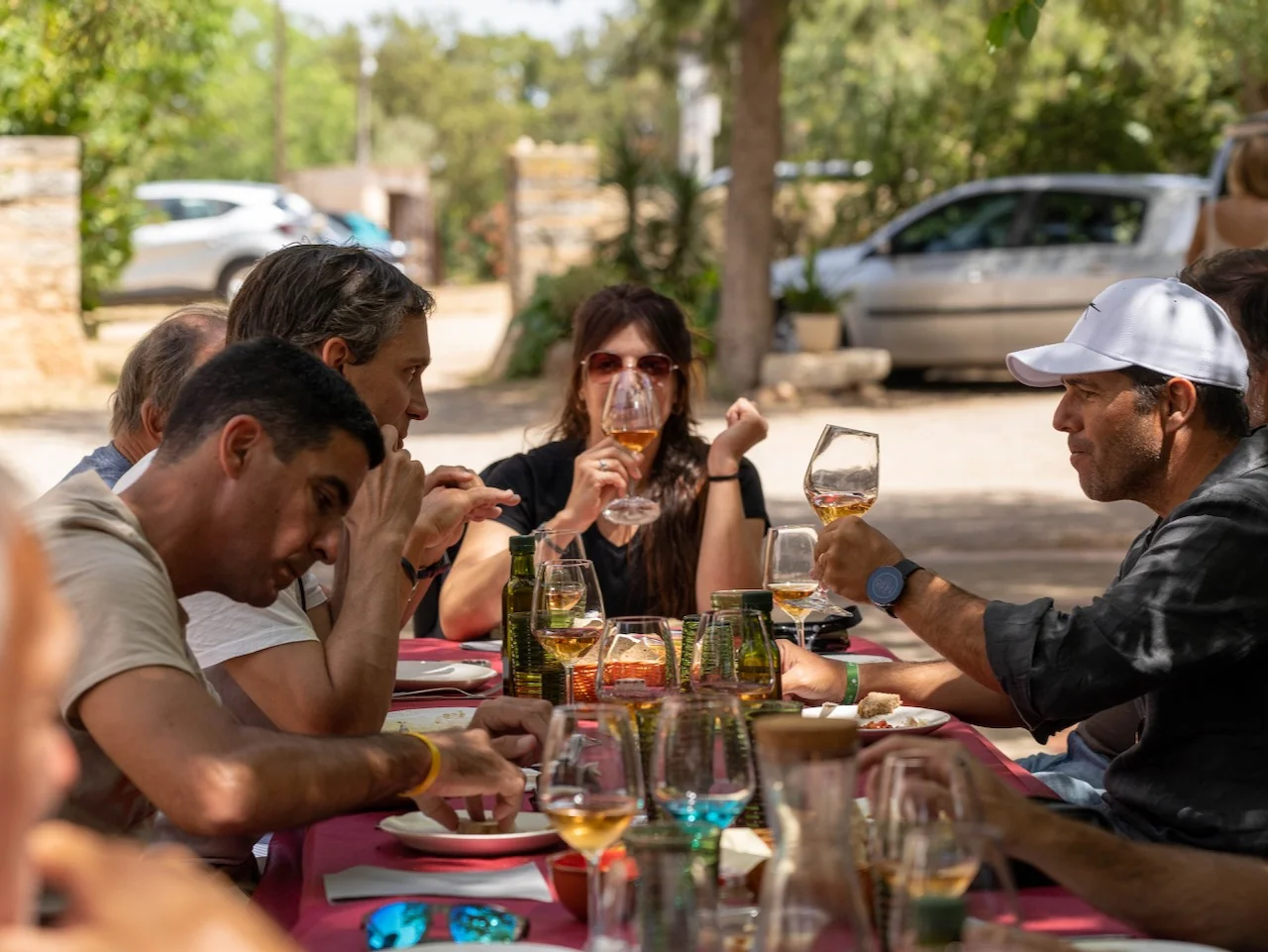
Their products are sold through selected establishments across Mallorca, but the heart of the project is the farm itself. On weekends, the gates open to riders, walkers, travellers and curious visitors who want to connect with the island beyond the surface. Tastings here feel informal and unhurried – less about labels, more about landscape, people and shared tables. It’s a place that captures Mallorca’s true spirit: grounded, generous and quietly intentional.
Son Moragues – olive oil, citrus and heritage
Perched high in the Tramuntana mountains, Son Moragues feels like a living archive of Mallorcan agriculture. The estate is known for its olive oil, citrus fruits and traditional farming methods that predate modern shortcuts.
Their olive oil is intensely aromatic, grassy and slightly peppery – the kind that transforms even the simplest slice of pan moreno. It’s often used sparingly, not because it’s precious, but because it deserves attention.
Visiting or tasting Son Moragues products is a reminder that Balearic food culture isn’t about trends. It’s about continuity.
Petit Celler 7103 – wine without ego
Petit Celler 7103 is proof that Mallorcan wine doesn’t need to shout to be interesting. This small winery focuses on balance, drinkability and respect for the land.
Their wines feel approachable but thoughtful – the kind you open at lunch and end up talking about over dinner. There’s a strong sense of restraint here, letting the grapes do the talking rather than overpowering them with technique.
For travellers exploring Mallorca’s wine scene, producers like this show why the island has quietly earned respect far beyond the Balearics.
Treuer – olive oil rooted in family and island rhythm
Treuer is, at its core, a family story. The Miralles family have deep roots in Mallorca, and their olive oil project grew from a desire to return to something slower, more grounded and more in tune with the island itself. After years working in tourism, Joan Miralles decided to step back onto the land with a clear vision: to create a natural, sustainable olive oil that reflected Mallorca’s calm, Mediterranean character.
The farm is more than a business. It’s a place where generations meet, where Sunday lunches are as important as the harvest, and where shared meals keep family traditions alive. When the next generation, led by Miquel Miralles Jr., took on the day-to-day running of Treuer, the philosophy stayed the same. What changed was the way the story was told -with a renewed focus on presentation, communication and bringing their olive oil to a wider audience, without losing its soul. Treuer remains a product of patience, land and family continuity.
Son Puig – centuries of winemaking history in the Tramuntana
Son Puig is one of Mallorca’s most historic wineries, with roots that stretch back centuries into the Serra de Tramuntana. Set in a traditional finca near Puigpunyent, the estate has long been shaped by the rhythms of the mountains, producing wines in a landscape where viticulture has always demanded respect for nature.
Today, Son Puig is still family-run, blending historical knowledge with careful modern winemaking. Old vines, stone terraces and traditional buildings tell the story of generations who worked this land long before wine tourism existed. Visiting Son Puig feels like stepping into Mallorca’s agricultural past – one where patience, craftsmanship and heritage matter more than trends. Their wines reflect that philosophy: elegant, structured and deeply connected to place.
Ibiza: small-scale, soulful and quietly exceptional
Ibiza’s food producers often fly under the radar. The island’s reputation tends to focus elsewhere, but scratch beneath the surface and you’ll find a deeply rooted agricultural culture.
Aubergine – more than a restaurant
Aubergine is often talked about as a dining destination, but at heart it’s a celebration of local farming. Many of the vegetables, herbs and edible flowers come directly from nearby plots, grown with care and intention.
What makes Aubergine interesting isn’t just what’s on the plate, but how closely it’s tied to its growers. Menus shift with the seasons, and ingredients are treated with respect rather than decoration.
It’s a clear example of Ibiza’s farm-to-table philosophy done quietly and well.
Can Musón – ecological farming with heart
Founded in 2009, Can Musón is an organic farm rooted in Ibiza’s rural traditions and run with a strong sense of purpose. Led by María Marí, an Ibicenca with deep family ties to the island, the finca focuses on ecological production, animal welfare and hands-on experiences that reconnect people with the land. Visitors can see where food is grown, meet traditional farm animals and taste homemade dishes prepared with care, all while sharing in a warm, community-driven atmosphere that reflects Ibiza’s agricultural soul.
Ses Cabretes – reviving Ibiza’s cheesemaking heritage
Ses Cabretes was born when Fina Prats and Pilar González decided to change direction and return to the countryside. Around a decade ago, a communal cheesemaking project supported by the Ibiza Local Council brought goats, land and cheesemaking together – and in 2016, the first Ses Cabretes cheeses were released. Today, the project is recognised for producing fresh and semi-cured goat’s milk cheeses made by hand, without preservatives and using vegetable rennet. Beyond quality, Ses Cabretes plays an important role in preserving Ibiza’s culinary heritage and protecting the native Pitiusa goat, a breed at risk of disappearing. It’s a quiet but powerful example of a new generation bringing life back to Ibiza’s rural traditions.
Bread: the quiet hero of Balearic tables
Bread rarely gets the spotlight, but in the Balearics it’s essential. From pan moreno in Mallorca to rustic loaves in Ibiza, bread is part of every meal.
Many bakeries still work with long fermentations and local flours, producing bread that’s meant to be eaten the same day. It’s simple, filling and deeply satisfying – especially when paired with olive oil, cheese or sobrasada.
Understanding bread here helps you understand how people eat: slowly, communally, and without fuss.
Bread makers keeping Mallorca’s traditions alive
Fornet de la Soca – heritage grains and lost recipes
Fornet de la Soca is often mentioned whenever Mallorca’s bread traditions come up, and with good reason. This Palma-based bakery focuses on recovering ancient grains, traditional milling methods and recipes that had almost disappeared. Their loaves are dense, flavourful and deeply tied to Mallorcan food culture, made with flours like xeixa and moreno wheat. It’s the kind of bread that tells a story with every slice – not designed for trends, but for continuity.
Panadería Ca’n Molinas (Valldemossa) – bread with mountain character
Best known for sweet pastries, Ca’n Molinas also produces traditional breads that reflect Valldemossa’s cooler mountain climate. Thick crusts, slow fermentation and simple ingredients define their approach. It’s a reminder that bread on the island changes subtly from village to village, shaped by geography as much as by recipe.
Why meeting makers changes how you taste
Once you’ve met a producer, food tastes different. You notice details. You ask questions. You understand why something costs what it does – and why it’s worth it.
That’s why so many of our Food Tours Balearics experiences are built around producer-led stories, even when the makers themselves aren’t physically present. Their work is on the plate, in the glass, and in the conversations that surround it.
How to experience Balearic producers as a traveller
You don’t need to visit every finca or vineyard to connect with local producers. Some of the best ways include:
- Choosing restaurants that name their suppliers
- Visiting local markets early, when producers are present
- Joining food and wine routes that explain what you’re tasting
- Asking where ingredients come from – locals love to tell you
This approach lets you explore freely while still understanding the story behind each flavour.
The real taste of the Balearics lives with its makers
Mallorca and Ibiza’s food culture isn’t defined by trends or techniques. It’s defined by people – the ones who plant, harvest, ferment, age and bake.
Meet the makers, and the islands make more sense.
And when you’re ready to connect those stories to memorable meals, Food Tours Balearics offers a way to explore that world naturally – through food, wine and the people who bring it all to life.